
For B2B sales teamsResearch done before the first call

Give your sales team more time with customers.

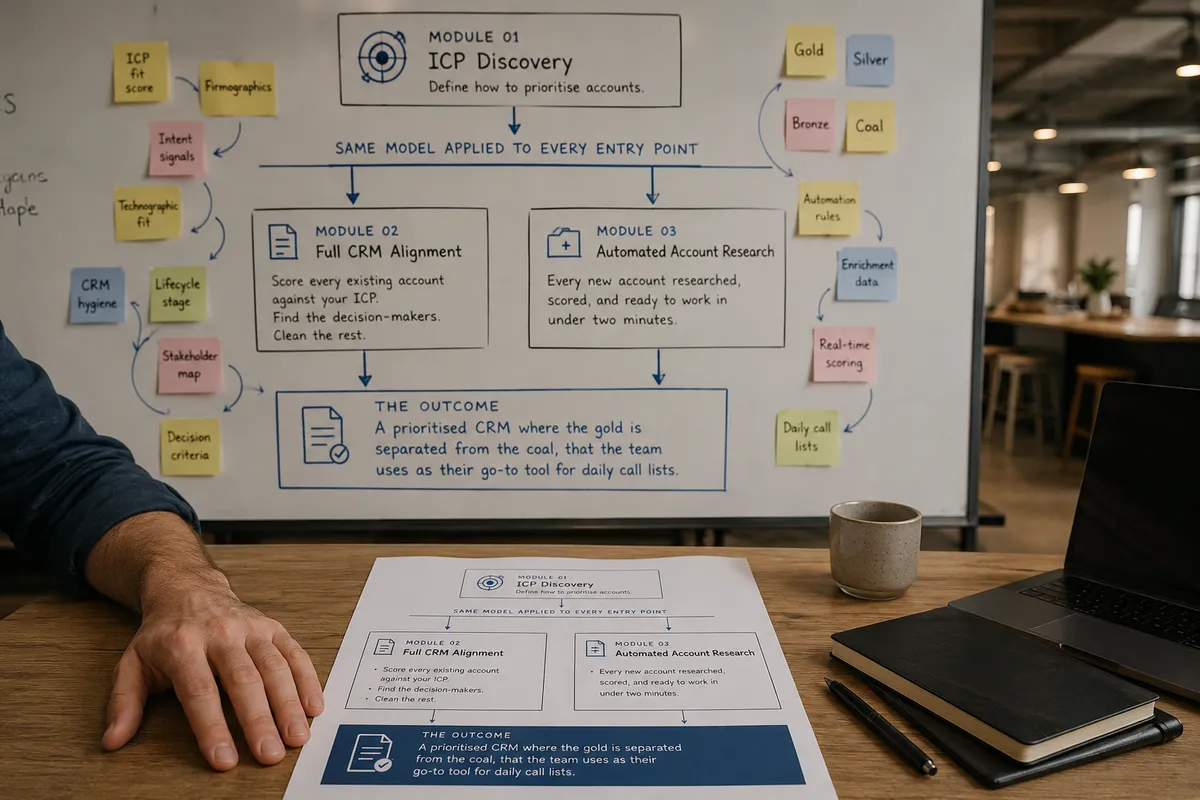
We find the companies you want to sell to, research the business and find the people to speak to. The information goes into your CRM, so your team can get on with making contact.

If you already have a list, or a CRM full of records nobody quite trusts, we can start there as well.

Running inside industrial and B2B sales teams for the last three years. Every record on this site is a labelled fictional example.

Buying roles · 5 of 6 found · 3 emails verified
  • Decision makerDavid Brennan · Managing DirectorEmail verified
  • Budget holderRachel Ng · Finance DirectorNot verified
  • Sales leaderJames Okafor · National Sales ManagerEmail verified
  • Operations leadBen Walsh · Operations ManagerNot verified
  • BuyerCarlos Mendez · Purchasing ManagerEmail verified
  • Safety leadNot found yetNo email
Written to the record

Score, tier, reasons, each fact with its source, each person with a persona and email status. Updated on the agreed cycle. Also exported.

Still open: 4 items, shown on the record rather than hidden.

Illustrative reconstruction of a delivered CRM record · fictional data.1 whether the company fits, and why2 who to speak to, with an honest status against each3 where it all lands
Choose your starting point

Two ways in. Neither has to come first.

Find new prospects

Tell us which companies you want to reach and what makes them worth approaching. We find them, check them against your criteria and research them before anyone calls.

How we find new prospects →

Improve the records you already hold

We check the companies and contacts already in your CRM, fill the agreed gaps and flag what has changed, without overwriting what your team relies on.

How we work on your CRM →

On their own as well: finding the right people at accounts you already hold, and checking a bought or inherited list before it goes into the CRM.

What your team receives

One company, researched and ready for a first call.

A fictional example. The fields and the scoring depend on your sale, and some information is not available for every company, so the gaps are shown rather than hidden.

Fictional example · the fields and scoring depend on your saleGold · 84/100

The company

Meridian Industrial Supply · Sydney, NSW

Why it fits

  • Sells into mining, construction and manufacturing, the industries in the agreed profile
  • A distributor rather than an end user, which is who the profile describes
  • Between 240 and 280 staff, inside the agreed size range

The score is 84 out of 100 across four weighted criteria your team agreed. How it is calculated, including the points withheld for what could not be confirmed.

The people to speak to · 5 of 6 found

  • Decision makerDavid Brennan, Managing DirectorEmail verified
  • Budget holderRachel Ng, Finance DirectorEmail not verified
  • Sales leaderJames Okafor, National Sales ManagerEmail verified
  • Operations leadBen Walsh, Operations ManagerEmail not verified
  • BuyerCarlos Mendez, Purchasing ManagerEmail verified
  • Safety leadNot found yetNot found yet

3 emails verified. Finding a role, verifying an email and finding a phone number are three different things, so each is shown on its own.

Where it goes. Written to the company and contact records in your CRM, with the score, the tier, each persona and the source of each fact. Also available as an export.

Still open. Number of sites not confirmed; Safety lead not found yet; Two email addresses found but not verified; No direct phone number for James Okafor.

See the complete example, before and after →
How it works

Agreed criteria in, researched records out.

You supply the target, the people who know your customers, access to the CRM and anything that is off limits. You approve the field mapping, the first batch and any outreach before it goes. Everything else runs on those rules.

  1. You supplyAgreed criteria

    What a good customer looks like, which buying roles matter, which fields you need, and what is off limits.

  2. Runs on the rulesCompany research

    Matching companies found or taken from your CRM, the facts collected with their sources, the score and tier worked out.

  3. Runs on the rulesBuying roles

    The roles filled where they can be, emails verified where they can be, and every gap left visible.

  4. After your review, if you want oneCRM delivery

    Written to the company and contact records, nothing of yours overwritten without a rule, and a weekly report of what changed.

Unknown information stays blank and marked, never guessed. Possible duplicates are held for review. Any part can be paused. The four steps, what you control and the tiers · How fit is scored

How you judge the work

A report every week, and the system on screen.

We have run this inside industrial and B2B sales teams for the last three years, across more than two million company and contact records researched, scored or checked. Clients stay anonymous; on a call we can talk through comparable work in your market. What we show instead is the report and the application itself.

Weekly reportWeek ending 17 October 2026 · fictional figures
Companies researched this week
120 of the 480 agreed
Fit the profile
41 accepted · 68 excluded · 11 held for review
Buying roles
173 of 246 found · 118 emails verified
Written to the CRM
41 companies · 173 contacts · 0 of your values overwritten
Still open
73 roles not found yet · 19 companies without a confirmed site count
Changed since last week
12 contacts moved roles · 3 companies re-scored on new information
An excerpt from the report every engagement gets each week, with invented numbers. What was completed, what was excluded, what is still open, and what changed.

The introduction6 min 32 secSound on

Questions

Four things people ask first.

Short answers. All the buying questions, including what happens to your existing contacts and what gets reviewed before anything is sent, are on the how-it-works page.

What does setup involve, and how much of our time?
A working session or two with the people who know your customers, to write down the profile and the buying roles. Then agreeing the fields and where you want to review results. After that your involvement is reviewing what comes back and telling us what to adjust. We configure and run the rest.
Which CRMs do you work with?
HubSpot. The research, the score, the people and the weekly report all land in HubSpot records and fields today. We are working on options for other CRMs; if you use something else, tell us which and we will say plainly where that stands. An export is available in the meantime.
What might stay unknown?
Some facts cannot be confirmed from public sources, some companies have a small digital footprint, and some roles cannot be found or have no verifiable email. In those cases the field stays blank and is marked as not found or not verified. We would rather show a gap than guess.
How is the cost worked out?
From the work involved: how many companies and contacts, how deep the research goes, and which parts keep running week to week. There is no published price list. After a conversation about your target market we come back with a proposal that sets this out.
Enquire

Tell us what you want your sales team to spend less time doing.

Whether you need new prospects, better information on the companies you already hold, or help keeping the CRM current, give us a bit of context. We will come back to you to discuss what would be involved.
What do you need first?
We reply to this address, and the company behind it is part of how we understand the enquiry.
We reply by email, usually with a few questions, and then arrange a call. How we handle what you send.

Prefer email? Write to matthew.steele@aligniqx.com.

A diagram of the research, scoring and contact finding running around a CRM
PracticeAlignIQx
ContactMatthew Steele
Webaligniqx.com